Thinking, Fast and Slow
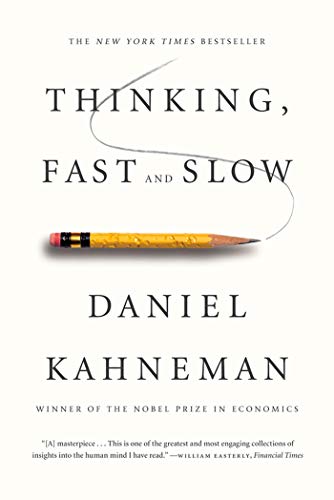
*Major New York Times Bestseller
*More than 2.6 million copies sold
*One of The New York Times Book Review's ten best books of the year
*Selected by The Wall Street Journal as one of the best nonfiction books of the year
*Presidential Medal of Freedom Recipient
*Daniel Kahneman's work with Amos Tversky is the subject of Michael Lewis's best-selling The Undoing Project: A Friendship That Changed Our Minds
BUY THE BOOK
Community Reviews
What Bookclubbers are saying about this book
✨ Summarized by Bookclubs AI
Readers say *Thinking, Fast and Slow* is a groundbreaking exploration of human thought, revealing how two brain systems shape our decisions. They agre...
A compelling journey into the human mind, revealing our often misguided intuition and our struggle with statistical thinking. The book illuminates our deep-seated biases and how rational choices are frequently counterintuitive. Kahneman skillfully navigates through decision theory and behavioral economics, highlighting our vulnerability to framing effects and the power of statistics in revealing both our knowledge and ignorance. It’s an essential read for those looking to understand the intricacies of human thought and decision-making.

A compelling journey into the human mind, revealing our often misguided intuition and our struggle with statistical thinking. The book illuminates our deep-seated biases and how rational choices are frequently counterintuitive. Kahneman skillfully navigates through decision theory and behavioral economics, highlighting our vulnerability to framing effects and the power of statistics in revealing both our knowledge and ignorance. It’s an essential read for those looking to understand the intricacies of human thought and decision-making.
While there are many great concepts in this book, for me it suffered from the following:
1) A lot of this research- even Kahneman's personal research - has been widely cited in more recent books which I read first.
2) Some of it is an explanation of basics statistics such as regression to the mean. While most of the population might not be familiar with basic stats, if you are, this part might be a bit belabored. (And for people that aren't familiar with basic stats, this book might be basically unreadable because I'm not convinced that the author did a good job of explaining it.)
3) It was too long. It covered too many "biases" and there were too many many examples of each kind of bias. I almost gave up on the book because I was going insane from the length and repetition.
Ah it was so brilliant that it hurt my mind. Like really ouch! Some really interesting concepts, packed with experiments, data and psychology. I couldn’t retain it all though. Too much data and detail but can understand why it’s so groundbreaking. If there was a synopsis version I would say everyone should read it. But without that? Then good luck. Good but oh so dense.
Today Dhir presented the book summary for the International bestseller _Thinking, Fast and Slow_. *There exists two systems within our brain*: "Reactive system" that is designed to arrive at conclusion instantly. It is formed on the basis of our experiences, beliefs, our upbringing and years of practice. It is designed to not burden the brain and enabling it to function in auto pilot mode by leveraging our perception, intuition and associative memory. Murali illustrated the point through an exercise. Repeat SILK 5 times, now answer the Q - "What does cow drink". If your answer is Milk then it's this system answering and associative memory kicking in. On the the other hand, "lazy system" gives more thought. It makes you pause and think of the context and reasons before jumping to conclusions. Obviously, it requires more energy and effort from our end to use this system resources.
Imagine a seasoned driver who is able to chat with others in the car, answer phone calls and gaze out of the window all of this while driving. This is the first system at work. On the other hand, someone who is learning to drive, requires second system to pitch in and would not like to be disturbed while their gaze is fixed on road ahead.
There are physiological cues like heart rate and dilation of pupils that indicate which system is currently functioning.
*Is one better than other?*
We require both. However, it is critical to judge the situation and make a conscious choice between "Thinking fast and thinking slow". If we have some inconsequential and everyday decisions to make, we have to rely on first system's ability to make quick choices. For impactful decisions like investments, we invariably use the second system. Important is to be aware which system is under work and switch to second one to avoid making a mistake by making an easy choice.
Like always there were multiple associated discussions on believing in random successes, reversion to mean, correlation Vs causation, anchoring and Marshmallow experiment on delayed gratification. A great and enlightening discussion as always.
See why thousands of readers are using Bookclubs to stay connected.